Do I Need a Therapist, a Doctor, or a Coach in Midlife?
They are three different jobs, and in midlife you frequently need more than one. A clinician treats your body. A therapist works with what has wounded you. A coach works with who you are becoming and what you are building. Start with the clinician. Add the others based on what the question underneath is actually about.
Start with the medical door
If your sleep is broken, your cycle has changed, your energy has dropped off a cliff, or your mood has shifted in a way that feels physical ~ that is a conversation with a qualified clinician, and it goes first.
Not because the other work matters less. Because you cannot think clearly about your life on four hours of fragmented sleep, and no amount of coaching substitutes for the right medical care.
Find someone who takes menopause seriously. If you are dismissed, find someone else. You are allowed to keep going until you are heard.
What a therapist is for
Therapy works with injury and with patterns that have roots.
Grief. Depression and anxiety that are not situational. Trauma. A relationship dynamic that repeats no matter who you are with. Anything where the honest description is I am carrying something heavy and it has been heavy for a long time.
A good therapist is trained for that, and coaching is not a substitute for it. If you are in the territory where you cannot function, or the weight is on you in a way that frightens you, that is the door to walk through first. I say this as someone who refers women to it regularly.
What a coach is for
Coaching works forward. It starts from the premise that you are not broken ~ you are at a threshold, and you need to decide what happens next and who you are on the other side of it.
That shows up as: the business is fine and you are not. The role no longer fits and you cannot say it out loud. You hit every target and felt nothing. You are leading a team while unrecognizable to yourself. You know something has to change and you do not know which thing.
Those are not clinical questions. They are identity and strategy questions, and they need someone who can hold both at once.
How to tell which one you need right now
Try this. Finish the sentence honestly.
My body is not working the way it used to ~ clinician.
I am carrying something that happened to me ~ therapist.
I built a life that no longer fits and I do not know who I am without it ~ coach.
Most women in midlife say more than one of those. That is normal, and it does not mean you have to choose. The three roles are not competitors. I have clients who see me, a clinician, and a therapist in the same season, and every one of those relationships is doing something the others are not.
Why an executive coach, specifically
This is the distinction that matters most for women running real businesses and real teams.
A general wellness coach will work on your habits. A menopause coach will work on your symptoms. Both have their place. But if you are an executive or a business owner, your midlife question arrives wearing business clothes. It sounds like a revenue problem, a team problem, a what-do-I-do-about-this-role problem.
And underneath it is an identity problem that will not be solved by a better calendar.
What you need is someone who can work the business question and the thing underneath it in the same conversation, without flinching from either. That is the whole reason my practice is shaped the way it is.
What to look for in a coach
Ask about credentials and ask what they are trained in. ICF credentialing means a real standard was met. Ask what happens if something clinical surfaces ~ a coach worth hiring has a clear answer and a referral list.
Ask them what they will not do. The honest ones have a list.
And notice whether they are selling you an outcome or a conversation. Anyone promising you a new self in six weeks is selling the same optimization story you came in exhausted by.
If the third sentence was yours
If you read I built a life that no longer fits and felt it land, that is the work I do.
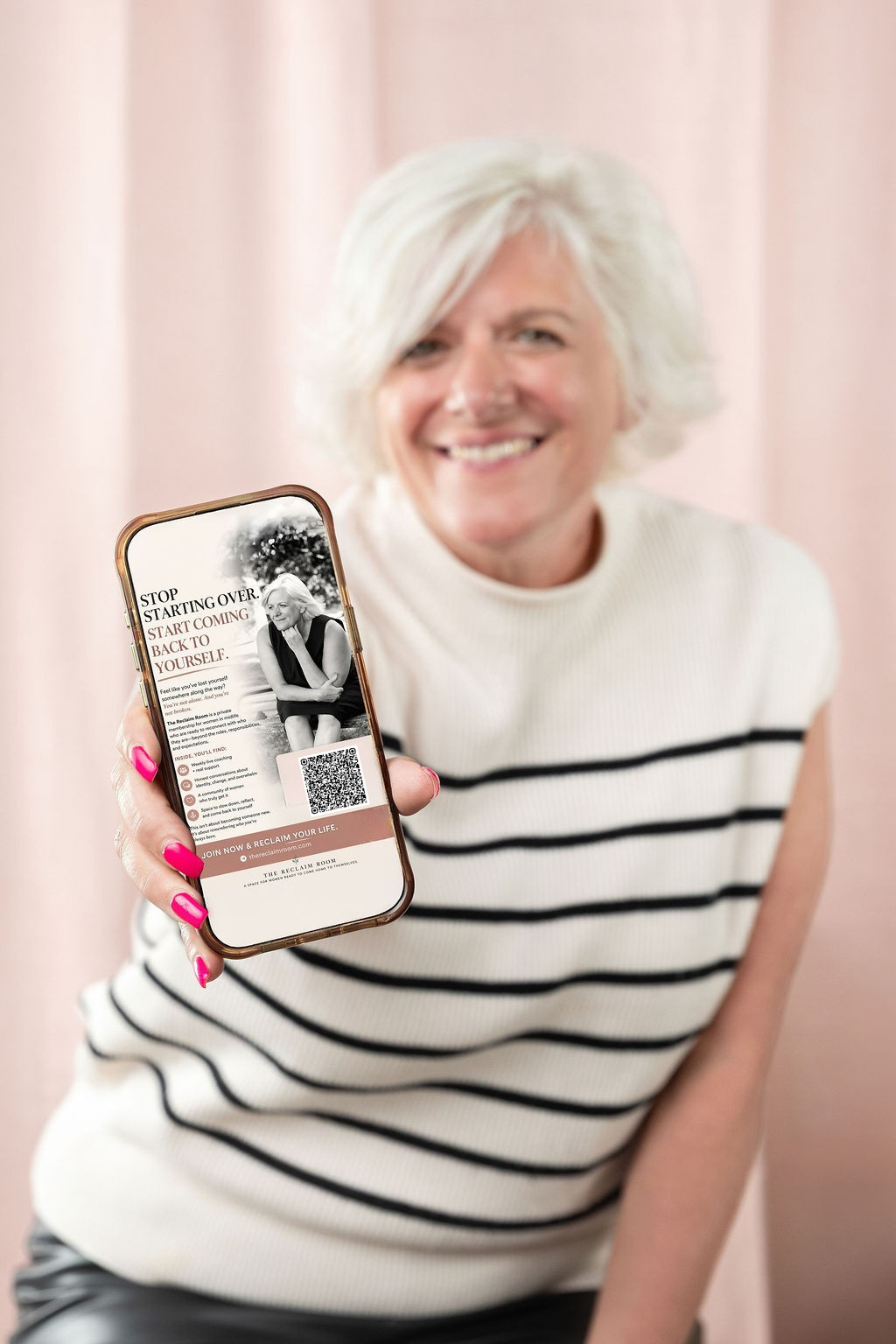
The Reclaim Room is where it starts for most women ~ live coaching, the Reclaim Pathway, and a room of high-achieving women asking the same question out loud. One-to-one work is there when the question gets specific to your business and your life.
Get your medical care. Get support for what is heavy. And then come ask the question nobody else is asking you.