Why Do I Feel Like a Different Person in Midlife?
Because you are. Something in you is reorganizing, and the version of you that ran the last twenty years is losing her grip on the controls. That feels like losing yourself. It is closer to the opposite ~ the performance is getting harder to hold, and what is underneath it is getting louder.
What women describe when they say this
It is rarely dramatic. It is small and constant and hard to say out loud.
You cry at something that would not have touched you two years ago. You cannot summon the enthusiasm you used to produce on command, and you notice yourself faking it. You snap at someone you love. You sit in a meeting you used to lead easily and feel like you are watching yourself from the hallway.
And then the thought arrives: I do not know who this is.
Is this hormones or is this me?
It is both, and the split is a false one.
Your body is moving through a real transition, and it changes your sleep, your energy, your emotional volume. Take that seriously and take it to a clinician who takes it seriously too.
But the reason this season feels like an identity crisis and not just a rough patch is that it is one. Not in the frightening sense. In the structural sense.
What was actually holding you together
For most high-achieving women, the self that gets built between twenty-five and forty-five is assembled out of usefulness.
You are the one who delivers. The one who holds it together. The one everyone leans on, the one who never drops the thing, the one whose value is legible because it is measurable. That identity is not fake. It is just narrow. And it runs on a particular fuel: performance, override, and the quiet belief that rest has to be earned.
Midlife takes that fuel away.
Not all at once. But enough that you cannot power the performance the way you used to. And when the performance thins, the woman underneath it becomes visible ~ to you, often for the first time in decades.
She is a stranger because you have not spent time with her. Not because she is not you.
Why it feels like a warning sign
Because every story you have been told about this season is a story about decline.
Losing your edge. Losing your looks. Losing your memory, your relevance, your place. So when you feel unfamiliar to yourself, you reach for the only explanation available: something is going wrong.
There is another reading. You are not disappearing. You are being un-narrowed.
What to do with the feeling instead of fixing it
Resist the urge to make yourself a project. That is the trained response ~ something feels off, so you optimize. A new protocol, a harder workout, a stricter plan, one more round of self-improvement pointed at a woman who does not need improving.
Try this instead. When the unfamiliar feeling arrives, do not manage it. Ask it what it wants.
Not metaphorically. Literally. What am I done pretending about? The answers tend to be specific and inconvenient. A role you have outgrown. A yes you have been giving for nine years. A version of success you chose at thirty that does not belong to you anymore.
That is not a crisis. That is information you have been too busy to receive.
Who you are becoming
The women I work with do not come out of this season as their old selves. That is the part nobody tells you, and it is the best part.
They come out less interested in approval. Clearer about what they will and will not carry. Better at their work, frequently, because they stop spending half their energy on the performance of being fine.
The stranger in the mirror is not a replacement. She is a homecoming.
If you want company for this part
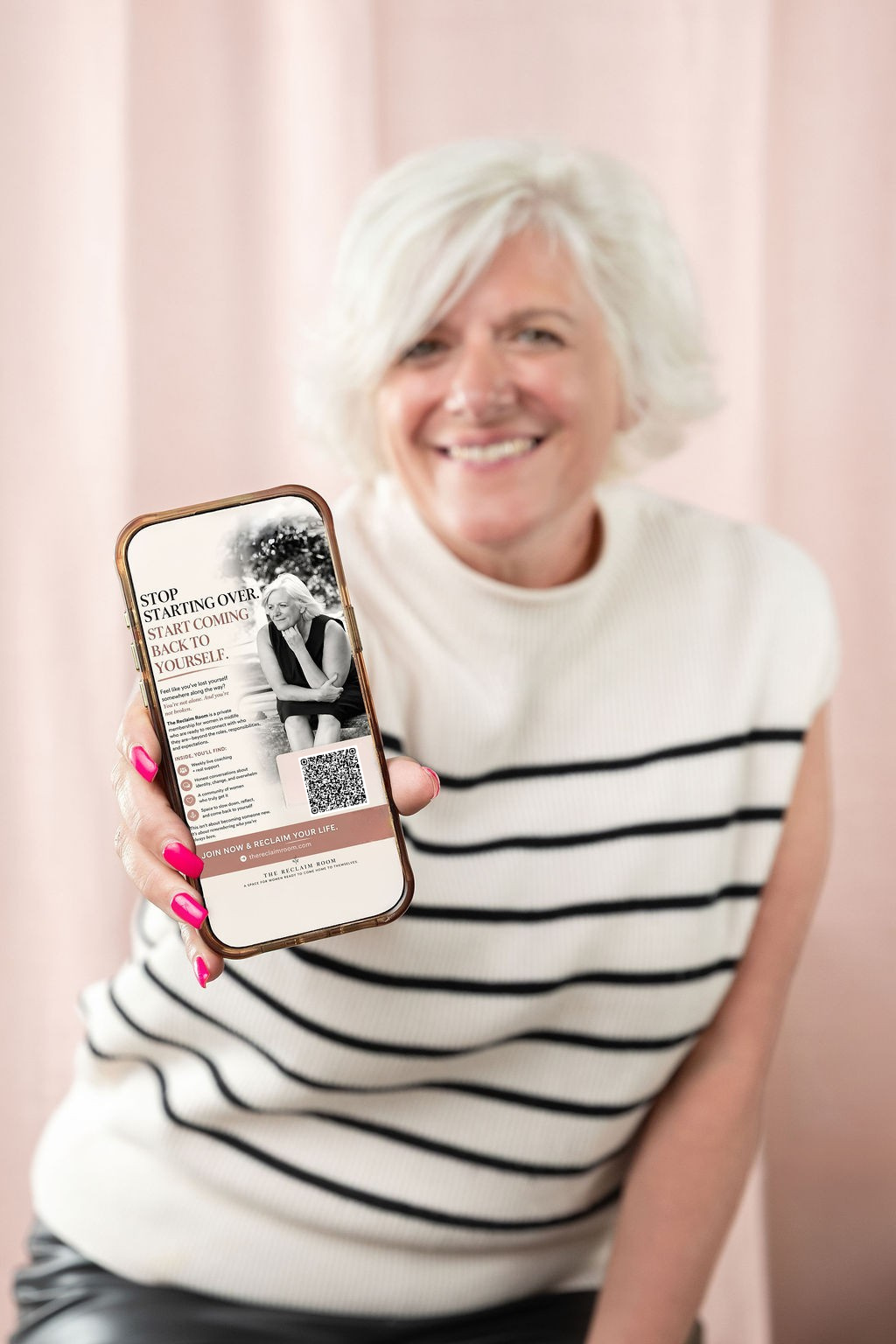
The Reclaim Room exists for exactly this conversation ~ women who are successful by every external measure and quietly unrecognizable to themselves, doing the work of figuring out who they are underneath the role.
You do not need to know who she is yet. You only need to stop calling her a problem.